


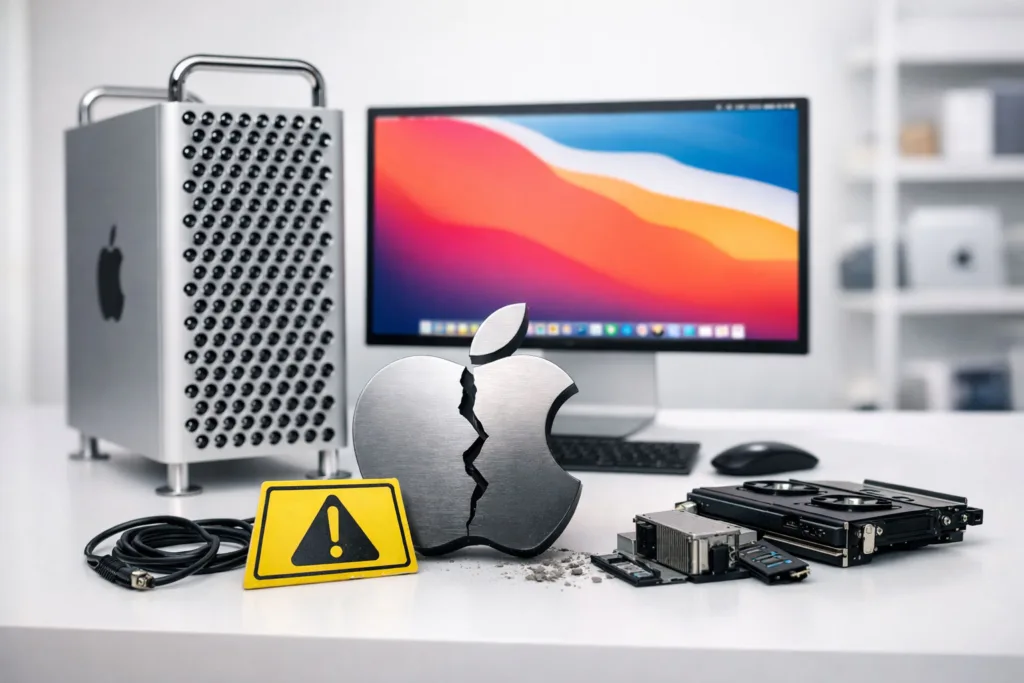
You’ve likely heard the news, or perhaps you’re seeing it now: Apple has officially discontinued the Mac Pro, and crucially, there are no immediate plans for a future hardware successor in the traditional, modular sense. This isn’t just another product refresh cycle ending; it marks a significant turning point in Apple’s professional desktop strategy. The cheese grater, the trash can, and their precursors have served a specific purpose for a dedicated user base, and their departure signals a shift in how Apple envisions high-end computing for creative professionals and power users. This isn’t a eulogy, but an explication of what this discontinuation means for you.
Understanding the Shift: The Evolving Definition of “Pro”
Apple’s definition of “Pro” has always been a fluid concept, adapting to technological advancements and market demands. Historically, the Mac Pro represented the pinnacle of macOS hardware, offering unparalleled expansion, performance, and upgradeability. It was the machine you bought when you absolutely needed the most powerful, adaptable Mac available, a testament to its modular design and often, its distinct aesthetic. However, over time, other Mac lines have encroached upon its territory, offering significantly more power than ever before.
The Rise of the M-Series Chips: A Paradigm Shift
The introduction of Apple’s silicon, specifically the M-series chips, has been the most disruptive force. These custom-designed processors have delivered astonishing performance and efficiency gains, blurring the lines between desktop and portable power. For many tasks that once demanded the raw horsepower and expandability of a Mac Pro, the M1, M2, and M3 families, particularly their Pro, Max, and Ultra variants, have proven more than capable. Your workflow, once tethered to the physical limitations of a traditional desktop, has become increasingly reliant on the integrated architecture of these SoCs.
The “Internal” Expandability of Apple Silicon
While lacking the PCIe slots of its predecessors, the M-series chips have offered a different kind of expandability. The ability to configure Macs with vast amounts of unified memory, multiple GPU cores, and specialized media engines within a single chip package means that many of the performance bottlenecks that once necessitated a Mac Pro are now addressed at the silicon level. This internal optimization has, in part, obviated the need for extensive external hardware. For many, the “expandability” now lies in the configurable options of the chip itself, rather than the swappable components of a traditional tower.
The Performance Leap: Is the Mac Pro Still the King?
The performance metrics of the M-series chips, especially in workloads optimized for them, have frequently surpassed or matched what was previously achievable with Intel-based Mac Pros. This is a critical factor. If a MacBook Pro or a Mac Studio can now perform the critical tasks of your workflow with greater speed and efficiency, the argument for a dedicated, expensive, and less portable Mac Pro becomes significantly weaker. You might find your current M2 Max MacBook Pro or M2 Ultra Mac Studio performing tasks that you previously reserved for a Mac Pro, diminishing the perceived need for a separate, distinct machine.
The “Pro” Beyond Raw Hardware: Software and Ecosystem
Apple’s vision of professional computing has also increasingly emphasized the seamless integration of hardware, software, and its broader ecosystem. This focus means that the “Pro” experience is not solely defined by the chassis and its internal components. It encompasses the optimized performance of macOS applications, the integration with services like iCloud, and the fluid transitions between devices. For many professionals, this holistic approach to computing holds as much value as the raw hardware specifications of a traditional workstation. Your workflow likely involves more than just a powerful desktop; it involves a connected environment.
In light of Apple’s recent decision to discontinue the Mac Pro with no plans for future hardware, it’s worth exploring how this shift in focus might influence the broader technology landscape. A related article discusses the future of computing technologies, particularly the potential of quantum computing and its implications for various industries. For more insights on this topic, you can read the article here: Quantum Computing in 2025: Separating Hype from Commercial Reality.
The Legacy of the Mac Pro: More Than Just a Machine
The Mac Pro has always been more than just a computer; it was a symbol. For a long time, it was the undisputed champion of macOS workstations, a testament to Apple’s commitment to professionals who demanded the very best. Its distinctive design, whether the classic “cheese grater” or the controversial “trash can,” made it instantly recognizable and often a point of pride for its owners. You might remember the satisfaction of slotting in a new graphics card, adding more RAM, or configuring it exactly to your specialized needs. This level of user-driven customization is now largely absent.
The “Cheese Grater” Era: Robustness and Expandability
The earlier generations of the Mac Pro, particularly the “cheese grater” models, were renowned for their robust build quality and exceptional expandability. These machines were built to last and to be adapted. You could outfit them with multiple hard drives, professional-grade graphics cards, and a host of other PCIe-based peripherals, tailoring them to the demanding needs of film editors, 3D animators, and scientific researchers. This was the era when the Mac Pro was the ultimate expression of modularity in the Apple ecosystem.
The Importance of PCIe Slots: A Vanishing Feature
The absence of PCIe slots in modern Macs is a significant factor in the Mac Pro’s discontinuation. For many specialized workflows, these slots provided the essential interface for high-bandwidth peripherals like professional audio interfaces, specialized video capture cards, and high-performance storage controllers. If your work directly depended on the connectivity provided by PCIe, you are undoubtedly feeling the impact of this shift. The flexibility to integrate third-party hardware has been a hallmark of high-end workstations for decades, and its diminished presence marks a departure from that paradigm.
The “Trash Can” Era: Controversial Design, Limited Success
The 2013 Mac Pro, with its cylindrical, compact design, was a radical departure from its predecessors. While visually striking and promising advancements in thermal management, it proved to be a controversial machine. Its limited expandability and the difficulty of user upgrades disappointed many of its core audience. While it offered significant processing power for its time, the lack of user-accessible expansion slots hampered its ability to adapt to evolving professional hardware requirements. This era highlighted the tension between design innovation and the pragmatic needs of professional users.
The Thermal Dynamics: A Double-Edged Sword
The thermal design of the “trash can” Mac Pro was a marvel of engineering, allowing for a compact form factor. However, it also limited the types of components that could be installed and how they could be configured. For tasks that generated sustained heat, the performance could be throttled to maintain system stability. This was a departure from the previous models, where robust cooling systems allowed for more aggressive configurations and sustained high performance. You might recall discussions about the machine’s thermal limitations and the impact it had on intense rendering or processing.
The Mac Studio and MacBook Pro: The New Guard of Apple’s Professional Lineup
With the Mac Pro now a chapter closed, Apple’s professional users are increasingly looking towards the Mac Studio and the higher-end MacBook Pro models. These machines, powered by the M-series chips, have become the de facto standard for many professional workflows. You will find them equipped with the most powerful configurations of Apple’s silicon, offering impressive performance without the need for traditional hardware modularity.
The Mac Studio: A Compact Powerhouse
The Mac Studio emerged as a compelling alternative for those who needed desktop-level power but didn’t require the full expandability of a Mac Pro. Its compact design houses incredibly powerful M-series chips, offering configurations that rival or surpass many previous Mac Pro models in raw performance. For many, the Mac Studio represents the sweet spot between power, portability (in the sense of being a dedicated desktop unit), and a more manageable footprint.
Unified Memory and Media Engines: Redefining Performance Bottlenecks
The unified memory architecture of the M-series chips in the Mac Studio is a significant factor in its performance. By allowing the CPU and GPU to access the same pool of high-bandwidth memory, it eliminates the latency associated with traditional separate memory pools. Couple this with the dedicated media engines for video encoding and decoding, and tasks that were once CPU-intensive and required specialized hardware accelerators are now handled with remarkable efficiency. You likely have experienced how quickly certain video projects can render or how smoothly demanding audio sessions play back on these machines.
The MacBook Pro: Power on the Go
The MacBook Pro, particularly the 14-inch and 16-inch models with M-series Pro, Max, and Ultra chips, offers a level of performance previously unthinkable in a portable form factor. For professionals who need to work on set, travel frequently, or simply prefer a more flexible workspace, the MacBook Pro has become an indispensable tool. Its integrated display and battery mean you can get a lot of work done without being tethered to a desk.
The Integrated Nature of Modern Laptops
The modern MacBook Pro is a testament to the integrated nature of Apple’s silicon. What was once a complex array of discrete components connected via buses is now a highly optimized SoC. This integration brings about incredible power efficiency, allowing for long battery life even under heavy load. For many users, the convenience and performance of a high-end MacBook Pro have rendered the need for a purely stationary workstation obsolete.
The Future of High-End Macs: What Comes Next?
The discontinuation of the Mac Pro, and the lack of immediate plans for a successor, signals a fundamental shift. Apple appears to be doubling down on its integrated silicon strategy, and for the foreseeable future, the most powerful Macs will likely continue to be based on M-series chips. This doesn’t necessarily mean an end to innovation, but rather a refocusing of that innovation.
The Potential for a “Mac Pro” Software Experience
While hardware modularity as we knew it may be gone, Apple could potentially offer a “Mac Pro” experience through software and optimized configurations. This could involve higher memory ceilings, more specialized silicon configurations within the M-series family, or enhanced support for professional-grade external hardware through Thunderbolt. The emphasis will likely be on making the most powerful M-series chips accessible in a desktop form factor that is optimized for professional use, even if it doesn’t have the same external I/O as previous generations.
Thunderbolt and Beyond: The Future of Connectivity
Thunderbolt has become the de facto standard for high-speed external connectivity on Macs. As Apple continues to advance its silicon, the capabilities of Thunderbolt will likely be further leveraged. This could manifest in more powerful eGPUs (though less likely given Apple’s silicon strategy), faster external storage solutions, and more sophisticated docking solutions that allow for a truly modular external setup. Your ability to connect high-performance peripherals will continue to be a critical aspect of your workflow.
The “Desktop” Experience: Refined and Integrated
The future of Apple’s high-end desktop experience will likely be one of refined integration. Instead of offering a chassis that can be populated with a wide array of third-party hardware, Apple is focusing on providing a highly optimized, all-in-one solution. This approach prioritizes performance, efficiency, and a seamless user experience. You may find that the next evolution of Apple’s professional desktop offerings will focus on pushing the boundaries of what can be achieved with integrated silicon, rather than relying on the flexibility of discrete components.
In light of Apple’s recent decision to discontinue the Mac Pro with no plans for future hardware, many tech enthusiasts are reflecting on the implications for professional users who rely on high-performance machines. This shift raises questions about the future of computing in creative industries, especially as companies increasingly prioritize cloud solutions and remote workflows. For those interested in understanding how to maintain high performance in such evolving environments, an insightful article discusses the role of observability in ensuring optimal API performance. You can read more about it here.
Your Workflow in the New Landscape
The discontinuation of the Mac Pro is not an indictment of your professional needs, but rather an evolution of how Apple is choosing to meet them. For many, the shift to M-series chips has already been a positive one, offering significant improvements in speed and efficiency. However, for those who relied heavily on the traditional expandability of the Mac Pro, this change requires careful consideration of your future hardware strategy.
Assessing Your Needs: Performance vs. Expandability
The key question for you now is to assess your workflow. If your work heavily relies on specialized PCIe cards or the ability to swap out major internal components, you will need to explore third-party solutions or potentially alternative operating systems. However, if your primary concern is raw processing power and the ability to handle demanding applications, the Mac Studio and high-end MacBook Pros are likely more than sufficient. You may already be experiencing this with your current M-series Mac.
The Role of Aftermarket Hardware and Services
As the Mac Pro fades into history, the ecosystem of aftermarket hardware and services will adapt. You might see more robust Thunderbolt enclosures for GPUs or storage, or specialized adapters that bridge the gap for legacy hardware. The focus will shift from internal upgrades to external connectivity solutions.
The Future of the “Workstation” from Apple
Apple’s commitment to professional users is not waning; it’s evolving. The Mac Pro as you knew it may be gone, but the pursuit of ultimate performance and a seamless professional experience continues. You will likely see continued innovation in Apple’s silicon, refining the power and efficiency that have already transformed the landscape. The future of your professional computing experience within the Apple ecosystem will be defined by the integrated power of its M-series chips and the continued development of its software and services. Your workflow will adapt, and the tools available to you will continue to push the boundaries, albeit in a different form than the towers of the past.
FAQs
1. Why is Apple discontinuing the Mac Pro?
Apple is discontinuing the Mac Pro due to declining sales and the company’s shift towards more consumer-focused products such as the MacBook and iMac.
2. Will there be any future hardware updates for the Mac Pro?
Apple has stated that there are no plans for future hardware updates for the Mac Pro, indicating that the product line will be discontinued.
3. What are the alternatives for professional users who rely on the Mac Pro?
Professional users who rely on the Mac Pro may consider alternative options such as the iMac Pro or the upcoming Mac Pro modular system, which is expected to be released in the future.
4. How will this decision impact professional users and the creative industry?
The discontinuation of the Mac Pro may impact professional users and the creative industry by limiting their options for high-performance desktop computing, potentially leading them to seek alternative solutions from other manufacturers.
5. What does this mean for the future of Apple’s hardware lineup?
The discontinuation of the Mac Pro may signal a shift in Apple’s hardware lineup towards more consumer-oriented products, such as laptops and all-in-one desktops, rather than high-end professional workstations.