



You’re likely using an AI chatbot. Perhaps you’re exploring its creative writing capabilities, seeking quick answers to complex questions, or even using it as a digital assistant to manage your tasks. You’ve probably marveled at its speed, its ability to synthesize vast amounts of information, and its nearly human-like conversational flow. This burgeoning technology promises a future of enhanced productivity and effortless information access. However, as you delve deeper, a less discussed, yet profoundly important, question begins to emerge: is this powerful tool inadvertently constructing the next digital walled garden?
The Allure of the Seamless Experience
You’re drawn to the AI chatbot because of its simplicity. You don’t need to navigate a labyrinth of search results, sift through countless articles, or piece together information yourself. The chatbot presents a curated, synthesized answer, often delivered with impressive eloquence. This “just give me the answer” mentality is incredibly compelling. Think about your interactions. You ask a question, and you receive a direct, almost immediate response. There’s no need to understand the underlying algorithms, the data sources, or the inherent biases that might be shaping the output. The experience is designed to be frictionless, and in that frictionless space, you can begin to surrender your critical faculties.
In the discussion surrounding the potential of AI chatbots to create the next walled garden, it is essential to consider how these technologies can optimize customer interactions and streamline workflows. A related article that delves into this topic is “The Frictionless Enterprise: 5 Steps to Optimizing Your Customer Journey Workflow,” which explores strategies for enhancing customer experiences through efficient processes. You can read more about these insights in the article here: The Frictionless Enterprise.
The Black Box of Information
When you ask a question, you aren’t seeing a direct link to a specific source from which the answer was pulled verbatim. Instead, you’re presented with a generated text. This is the inherent nature of large language models (LLMs). They process and generate text based on the patterns they’ve learned from massive datasets.
The Illusion of Neutrality
This “learned” response can create an illusion of neutrality. You might assume that because the chatbot is an AI, it’s objective, unswayed by opinion or agenda. However, the datasets used to train these models are, by their very nature, a reflection of the information that exists online. This means that existing biases, historical inequities, and dominant narratives are all present and can be amplified by the AI. You’re not getting a pure, unadulterated truth; you’re getting a statistically probable output based on a vast, and often imbalanced, collection of human-generated text.
The Opacity of Derivation
The opaque nature of how these answers are generated is a core concern. You don’t see the individual pieces of information that contributed to the final output. If the chatbot presents a factual claim, you can’t easily verify its origin. This lack of transparency makes it difficult to assess the credibility of the information or to delve deeper into a topic if you wish to explore perspectives beyond the AI’s synthesized summary. You’re relying on the AI’s interpretation, and that interpretation is, by design, hidden from you.
The Erosion of Information Discovery


Your reliance on the chatbot for information begins to subtly alter your discovery habits. Instead of actively searching, evaluating, and synthesizing information from multiple sources, you’re increasingly outsourcing this mental labor to the AI. This can lead to a passive consumption of information, where the act of seeking knowledge becomes less about critical engagement and more about passively receiving pre-digested content.
The Diminishing Incentive for Deep Dives
Why spend hours researching a complex historical event when you can get a concise summary in seconds? The immediate gratification offered by chatbots can diminish your incentive to engage in the deeper, more effortful process of information discovery. You might think you’re saving time, but you could be sacrificing depth of understanding and the development of critical research skills. The satisfaction of unearthing obscure facts or connecting disparate ideas through your own effort is replaced by the ease of a prompt.
The Concentration of Knowledge Access
As more people turn to these platforms for information, the control over that information becomes increasingly concentrated. The companies developing and deploying these chatbots become the gatekeepers of knowledge, able to shape what information is readily available and how it is presented. This creates a new kind of digital power imbalance, where your access to information is mediated by a select few. You might not see it as a restriction, but rather as an enhancement, but the effect is a narrowing of the points of access.
The Personalization Trap
AI chatbots are designed to be engaging and personalized. They learn your preferences, your communication style, and the topics you frequently discuss. This can create a highly tailored experience that feels remarkably attuned to your needs. However, this personalization can also create a form of digital echo chamber, reinforcing your existing beliefs and limiting your exposure to diverse perspectives.
The Algorithmic Reinforcement of Beliefs
Just as social media algorithms can create echo chambers, so too can AI chatbots. If you consistently ask questions or express opinions that align with a particular viewpoint, the chatbot may learn to present you with information that confirms those biases. This can lead to a situation where you are constantly being affirmed in your existing beliefs, with little exposure to counterarguments or alternative interpretations. You become increasingly entrenched in your own perspective, making it harder to engage with those who hold different views.
The Subtle Shaping of Worldviews
The cumulative effect of this personalized, yet potentially biased, information flow can be a subtle but significant shaping of your worldview. If the AI consistently presents information in a certain light, or omits certain perspectives, your understanding of the world can be unconsciously molded. This is not necessarily malicious intent on the part of the developers, but rather a byproduct of how these systems are designed to optimize for user engagement. You are, in effect, being fed a tailored diet of information, and that diet can influence what you believe to be true.
As discussions around the implications of AI chatbots continue to evolve, it’s interesting to consider how these technologies might influence broader trends in digital ecosystems. A related article explores the concept of sustainable IT and its growing importance as a key enterprise value metric, shedding light on how organizations can balance innovation with responsibility. For more insights on this topic, you can read the article here. This connection underscores the need for businesses to navigate the complexities of emerging technologies while fostering a sustainable future.
The Rise of Proprietary Ecosystems

This trend towards AI chatbots is closely intertwined with the development of proprietary ecosystems. Companies are investing heavily in these technologies, not just to provide a service, but to lock users into their platforms. As you become accustomed to the seamless experience and personalized outputs of a particular chatbot, the incentive to switch to a different platform diminishes.
Vendor Lock-in and Data Silos
The data you generate through your interactions with a chatbot is often proprietary. This data is then used to further refine the AI, creating a virtuous cycle for the company and a form of vendor lock-in for you. Your conversational history, your queries, your preferences – all of this is valuable data that can be used to enhance the service but also to make it harder for you to leave. You become a user of a specific platform, with your digital footprint increasingly tied to that particular ecosystem.
The Future of Openness and Interoperability
The growing dominance of these proprietary AI chatbot ecosystems raises serious questions about the future of open access to information and digital interoperability. If major platforms control the primary interface through which many people access and process information, it could stifle innovation and limit choices. The internet, in its early days, was envisioned as an open and decentralized space. The rise of these walled gardens threatens that ideal, potentially leading to a more fragmented and controlled digital landscape. You might not be actively seeking to be confined, but the design of these systems can lead you there.
Conclusion: Navigating the AI Frontier
Your engagement with AI chatbots is a defining characteristic of the current technological era. These tools offer undeniable benefits in terms of efficiency and accessibility. However, you must remain critically aware of the potential for these powerful systems to construct new forms of digital walled gardens. The opacity of information sourcing, the subtle reinforcement of biases, and the creation of proprietary ecosystems all represent challenges to open access and independent thought.
The Importance of Continued Critical Engagement
As you continue to interact with these technologies, make a conscious effort to question the information presented. Seek out diverse sources, verify facts independently, and be mindful of the potential for algorithmic bias to shape your understanding. Your digital literacy needs to evolve to encompass a critical understanding of AI.
Advocating for Transparency and Openness
Support initiatives that promote transparency in AI development and advocate for interoperability between different platforms. A future where AI enhances human knowledge requires an open and collaborative approach, not one that confines information within corporate fortresses. Your choices as a user, and your willingness to demand these qualities from technology providers, can influence the trajectory of this powerful new frontier. You are not merely a passive recipient of AI’s capabilities; you are an active participant in shaping its impact.
FAQs
What are AI chatbots?
AI chatbots are computer programs that use artificial intelligence to simulate human conversation through text or voice interactions. They are designed to understand and respond to user queries in a conversational manner.
What is a walled garden in the context of AI chatbots?
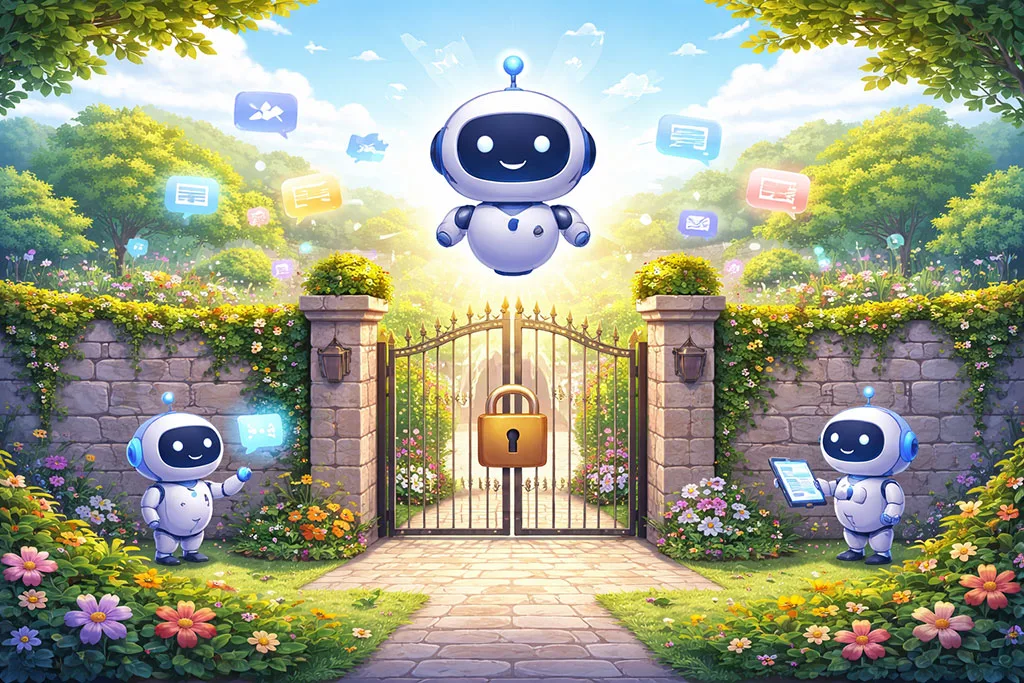
In the context of AI chatbots, a walled garden refers to a closed ecosystem where a chatbot is designed to keep users within a specific platform or service, limiting their interactions with external sources of information or services.
How are AI chatbots potentially building the next walled garden?
AI chatbots have the potential to build the next walled garden by offering a closed ecosystem where users rely solely on the chatbot for information and services, limiting their access to external sources and creating a dependency on the chatbot’s platform.
What are the potential implications of AI chatbots building the next walled garden?
The potential implications of AI chatbots building the next walled garden include limited access to diverse information and services, reduced competition and innovation in the chatbot market, and concerns about data privacy and user autonomy.
How can the development of AI chatbots be balanced to avoid creating a walled garden?
To avoid creating a walled garden, the development of AI chatbots can be balanced by promoting interoperability with external platforms and services, ensuring transparency in data usage and privacy policies, and fostering competition and innovation in the chatbot market.