


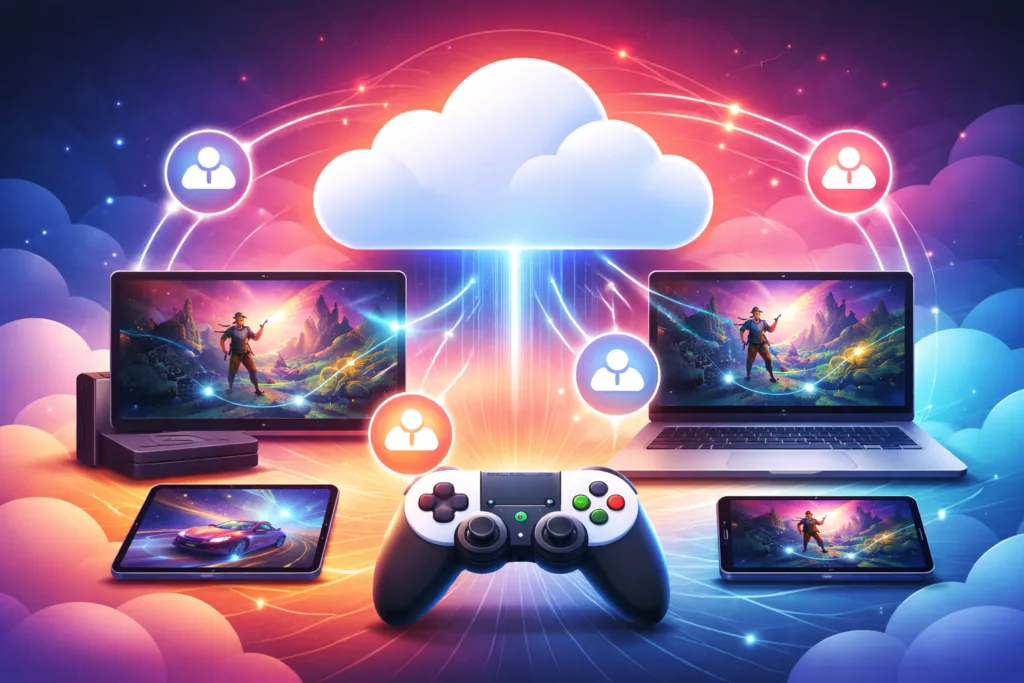
Cloud gaming has emerged as a revolutionary force in the gaming landscape, transforming how players experience and interact with video games. Instead of relying on powerful hardware to run games, cloud gaming allows users to stream games directly from remote servers. This enables high-quality gaming experiences on a variety of devices, from smartphones to low-end laptops, without the need for expensive consoles or gaming PCs.
This technology is reshaping both individual gaming habits and the broader industry structure. While the concept of cloud gaming is not entirely new, recent advancements in technology have propelled it into the mainstream. High-speed internet and powerful cloud computing capabilities now enable users to access extensive game libraries without traditional hardware limitations.
This technological shift removes previous barriers to entry, allowing for greater flexibility and convenience in gaming access. Cloud gaming offers a combination of accessibility and engagement that differs significantly from traditional gaming platforms.
Key Takeaways
- Cloud gaming offers instant access to games without the need for high-end hardware.
- 5G technology significantly enhances cloud gaming performance by reducing latency.
- Cross-platform play is becoming more feasible through cloud gaming services.
- Integration of VR and AR is expanding immersive experiences in cloud gaming.
- Ethical and legal issues, such as data privacy and licensing, are emerging challenges.
The Advantages of Cloud Gaming
One of the most significant advantages of cloud gaming is its accessibility. You no longer need to invest in expensive gaming consoles or high-end PCs to enjoy the latest titles. Instead, you can simply subscribe to a cloud gaming service and start playing on your existing devices.
This democratization of gaming means that more people can participate in the gaming community, regardless of their financial situation or technical expertise. You can easily jump into a game with just an internet connection, making it easier than ever to connect with friends and fellow gamers. Another key benefit is the convenience that cloud gaming offers.
With traditional gaming, you often have to download large files or install updates, which can be time-consuming and frustrating. In contrast, cloud gaming allows you to play games instantly without waiting for downloads or installations. You can switch between games seamlessly, trying out new titles on a whim without the commitment of purchasing them outright.
This flexibility enhances your gaming experience, enabling you to explore a diverse range of genres and styles without the usual constraints.
The Challenges of Cloud Gaming

Despite its many advantages, cloud gaming is not without its challenges. One of the most pressing issues is the reliance on a stable and fast internet connection. If your connection is slow or inconsistent, you may experience lag, buffering, or reduced visual quality while playing.
This can significantly detract from your gaming experience, especially in fast-paced action games where every millisecond counts. As you consider adopting cloud gaming, it’s essential to evaluate your internet capabilities and whether they can support the demands of streaming high-quality games.Another challenge lies in the potential for data caps imposed by internet service providers.
Many ISPs limit the amount of data you can use each month, and cloud gaming can consume a significant amount of bandwidth. If you’re not careful, you could quickly exceed your data limit, leading to additional charges or throttled speeds. This concern may deter some gamers from fully embracing cloud gaming, as they weigh the costs against the benefits.
Understanding these limitations is crucial as you navigate this evolving landscape.
The Impact of Cloud Gaming on the Gaming Industry
Cloud gaming is reshaping the gaming industry in profound ways. As more players turn to streaming services for their gaming needs, traditional game distribution models are being challenged. Publishers are beginning to rethink their strategies, focusing on subscription-based models that allow players like you to access a wide array of games for a monthly fee.
This shift could lead to a more sustainable industry where developers are incentivized to create high-quality content rather than relying solely on one-time purchases. Moreover, cloud gaming has the potential to foster greater innovation within the industry. With fewer hardware constraints, developers can experiment with new gameplay mechanics and design philosophies that may not have been feasible in traditional settings.
As a gamer, this means you’ll likely see more diverse and creative titles emerging from the industry as developers push the boundaries of what’s possible in game design. The rise of cloud gaming could usher in a new era of creativity and exploration in video games.
The Role of 5G in Advancing Cloud Gaming
| Average Latency | 30 | ms | Average round-trip time for cloud gaming input response |
| Average Bandwidth Usage | 15 | Mbps | Typical bandwidth consumption during gameplay streaming |
| Concurrent Users (Global) | 5,000,000 | Users | Estimated number of active cloud gaming users worldwide |
| Average Session Length | 45 | Minutes | Average duration of a cloud gaming session |
| Supported Devices | 10 | Device Types | Number of device categories supported (PC, mobile, smart TV, etc.) |
| Game Library Size | 1,200 | Games | Number of games available on a typical cloud gaming platform |
| Data Center Locations | 50 | Locations | Number of global data centers supporting cloud gaming infrastructure |
The advent of 5G technology is set to revolutionize cloud gaming even further. With its ultra-fast speeds and low latency, 5G networks can provide a seamless streaming experience that was previously unattainable with older technologies. As you transition into this new era of connectivity, you’ll find that 5G enables you to play graphically intensive games on mobile devices without sacrificing performance or quality.
This opens up exciting possibilities for gaming on the go, allowing you to enjoy your favorite titles wherever you are. Additionally, 5G’s capacity for handling multiple connections simultaneously means that more players can engage in cloud gaming without experiencing slowdowns or interruptions. This is particularly beneficial for multiplayer games where real-time interactions are crucial.
As 5G becomes more widespread, you’ll likely notice an increase in the quality and reliability of cloud gaming services, making it an even more attractive option for gamers like yourself.
The Potential for Cross-Platform Gaming with Cloud Gaming

Cloud gaming also paves the way for enhanced cross-platform play, allowing you to connect with friends regardless of their chosen devices. Traditionally, gamers have been limited by hardware compatibility issues; however, cloud gaming breaks down these barriers by enabling seamless play across various platforms. Whether you’re on a console, PC, or mobile device, you can join your friends in multiplayer experiences without worrying about compatibility.
This potential for cross-platform play not only enriches your social interactions but also fosters a more inclusive gaming community. You can team up with friends who may not own the same console or device as you do, creating opportunities for collaboration and competition that were previously difficult to achieve. As cloud gaming continues to evolve, expect to see even more emphasis on cross-platform capabilities that enhance your overall gaming experience.
The Future of Cloud Gaming Technology
As technology continues to advance at a rapid pace, the future of cloud gaming looks promising. Innovations in artificial intelligence and machine learning are likely to enhance game streaming services by optimizing performance based on individual user preferences and network conditions. This means that as a gamer, you’ll benefit from an increasingly personalized experience tailored to your specific needs and preferences.
Furthermore, advancements in graphics technology will enable cloud gaming services to deliver even more visually stunning experiences without requiring powerful local hardware. As streaming quality improves and latency decreases, you’ll find yourself immersed in rich, detailed worlds that rival those found on traditional consoles and PCs. The future holds exciting possibilities for cloud gaming technology that will undoubtedly enhance your enjoyment and engagement with video games.
The Evolution of Game Streaming Services
The landscape of game streaming services has evolved significantly over recent years, with numerous platforms vying for your attention. From established giants like Xbox Cloud Gaming and PlayStation Now to newer entrants like Google Stadia and NVIDIA GeForce NOW, there’s no shortage of options available for you to explore. Each service offers unique features and game libraries tailored to different types of gamers, allowing you to choose one that best fits your preferences.
As these services continue to develop and compete for your subscription dollars, you’ll likely see improvements in user interfaces, game selection, and overall performance. The competition will drive innovation as companies strive to provide the best possible experience for gamers like yourself. With so many choices at your fingertips, you’ll have the opportunity to find a service that aligns perfectly with your gaming habits and interests.
The Accessibility of Cloud Gaming for Gamers
One of the most compelling aspects of cloud gaming is its potential for increased accessibility among diverse audiences. By eliminating the need for expensive hardware investments, cloud gaming opens doors for individuals who may have previously felt excluded from the gaming community due to financial constraints or technical limitations. You can easily access a wide range of games without worrying about whether your device can handle them.
Moreover, cloud gaming can be particularly beneficial for those with disabilities who may struggle with traditional controllers or setups. Many services are beginning to incorporate adaptive technologies that cater to various needs, ensuring that everyone has an opportunity to enjoy video games. As accessibility continues to improve within cloud gaming platforms, you’ll witness a more inclusive environment where all gamers can thrive.
The Integration of Virtual Reality and Augmented Reality in Cloud Gaming
The integration of virtual reality (VR) and augmented reality (AR) into cloud gaming represents an exciting frontier for immersive experiences. As these technologies become more mainstream, you’ll find that cloud gaming platforms are beginning to incorporate VR and AR elements into their offerings. This convergence allows you to engage with games in entirely new ways, blurring the lines between reality and virtual worlds.
Imagine stepping into a game where you can physically interact with your environment or collaborate with friends in augmented reality settings—all made possible through cloud technology. As developers continue to explore these possibilities, you’ll likely see innovative gameplay mechanics that take full advantage of VR and AR capabilities within cloud gaming frameworks.
The Ethical and Legal Implications of Cloud Gaming
As with any emerging technology, cloud gaming raises important ethical and legal questions that warrant consideration. Issues surrounding data privacy and ownership rights come to the forefront as you engage with these platforms. When playing games through cloud services, you’re often required to agree to terms that may grant companies extensive rights over your data and gameplay experiences.
Additionally, concerns about content moderation and censorship arise as companies navigate the complexities of hosting user-generated content within their platforms. As a gamer, it’s essential to stay informed about these issues and advocate for transparency and fairness within the industry. By understanding the ethical implications surrounding cloud gaming, you can make informed choices about how you engage with this evolving medium.
In conclusion, cloud gaming represents a transformative shift in how you experience video games today. With its myriad advantages—such as accessibility, convenience, and cross-platform capabilities—cloud gaming is poised to redefine your relationship with interactive entertainment while also challenging traditional industry norms. As technology continues to advance and new innovations emerge, you’ll find yourself at the forefront of an exciting era in gaming that promises endless possibilities for exploration and enjoyment.
Cloud gaming is rapidly transforming the way we experience video games, allowing players to stream high-quality games without the need for powerful hardware. This shift in gaming technology is not only enhancing user engagement but also paving the way for innovative approaches in various fields. For instance, the concept of gamification, as discussed in the article on gamification in email, highlights how game-like elements can be integrated into different platforms to boost user interaction, similar to how cloud gaming is revolutionizing player experiences.
FAQs
What is cloud gaming?
Cloud gaming is a technology that allows users to play video games streamed directly from remote servers over the internet, eliminating the need for powerful local hardware.
How does cloud gaming work?
Cloud gaming works by running the game on a remote server in a data center. The server processes the game and streams the video and audio output to the player’s device, while the player’s inputs are sent back to the server in real-time.
What devices can be used for cloud gaming?
Cloud gaming can be accessed on a variety of devices including PCs, laptops, smartphones, tablets, smart TVs, and some dedicated streaming devices, as long as they have a stable internet connection and support the cloud gaming service.
Do I need a high-speed internet connection for cloud gaming?
Yes, a stable and high-speed internet connection is essential for cloud gaming to ensure smooth gameplay and minimal latency. Typically, a broadband connection with speeds of at least 10 Mbps is recommended.
Is cloud gaming subscription-based?
Many cloud gaming services operate on a subscription model, offering access to a library of games for a monthly fee. However, some services also allow purchasing individual games or offer free-to-play options.
What are the advantages of cloud gaming?
Advantages include no need for expensive gaming hardware, instant access to games without downloads or installations, the ability to play on multiple devices, and automatic updates and maintenance handled by the service provider.
Are there any disadvantages to cloud gaming?
Disadvantages can include dependence on internet quality, potential latency issues affecting gameplay, limited game libraries on some platforms, and concerns about data privacy and ownership.
Can I play multiplayer games on cloud gaming platforms?
Yes, many cloud gaming services support multiplayer games, allowing users to play online with friends or other players worldwide.
Is cloud gaming the same as game streaming?
Yes, cloud gaming is often referred to as game streaming because it involves streaming game content from the cloud to the player’s device.
Do cloud gaming services support all game genres?
Most cloud gaming platforms support a wide range of game genres, including action, adventure, RPG, sports, and strategy, but availability depends on the service’s game library.