


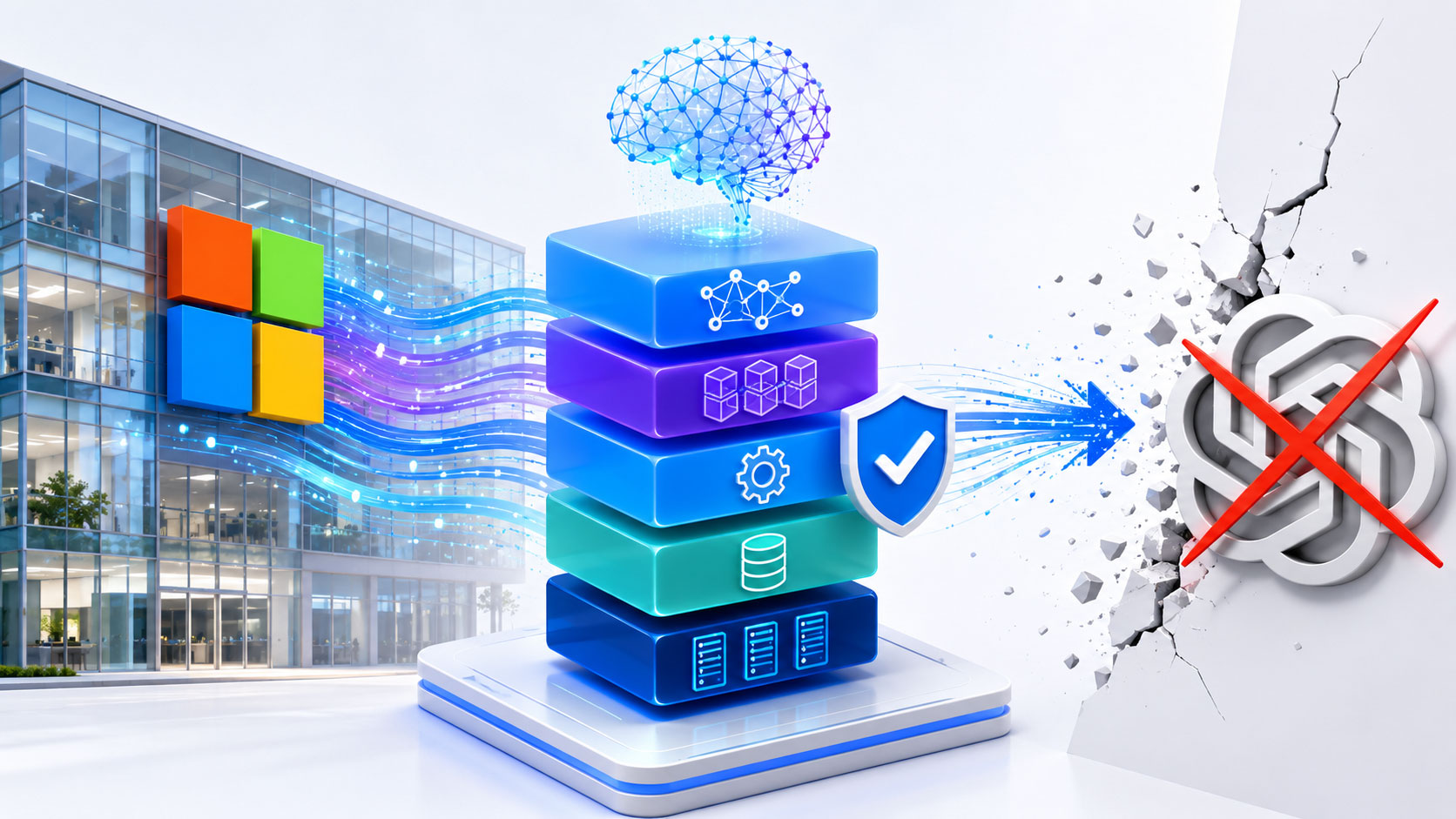
You’re staring at the news, a freshly brewed coffee steaming beside your screen. The headline screams: “Microsoft’s Independent AI Stack Cuts OpenAI Dependence.” Instinctively, you perk up. For years, the narrative has been clear: Microsoft, the strategic behemoth, and OpenAI, the groundbreaking innovator, a partnership born of necessity and evolving into a seemingly unbreakable bond. But now, this. You, as an industry observer, a technophile, or even a casual user of AI, understand the seismic implications. This isn’t just a corporate reshuffle; it’s a strategic realignment that redefines the future of artificial intelligence development, putting more power and control directly into Microsoft’s hands.
You can almost visualize the boardrooms, the late-night discussions, the whiteboards filled with complex flowcharts. The decision to build out an independent AI stack wasn’t a sudden impulse; it was a carefully calculated move, a response to a growing understanding of the criticality of AI and the inherent vulnerabilities of relying too heavily on a single external partner.
The Inevitable Evolution of Strategic Imperatives
Think back to the early days of the Microsoft-OpenAI partnership. You likely saw it as brilliant. Microsoft, with its deep pockets and cloud infrastructure, providing the fuel. OpenAI, with its nascent, cutting-edge research, providing the engine. It was a synergistic dream. However, as AI rapidly matured from a promising concept to an indispensable tool across every facet of technology, dependency began to breed unease. You understand that for a company of Microsoft’s scale and ambition, having open-ended reliance on a third-party for core intellectual property and strategic direction is a ticking time bomb. The potential for divergence in strategic goals, or even competitive friction, loomed large.
Learning from Experience: The Build-or-Buy Conundrum
Recall Microsoft’s history. You’ve seen them both acquire and build. Sometimes it’s faster to buy, sometimes more strategic to build. With OpenAI, the initial “buy” was an investment and a partnership. But as the value of the “buy” (their AI models) skyrocketed, so did the imperative for Microsoft to foster its own equivalent capabilities. You can imagine the internal dialogues: “What if OpenAI pivots in a way that doesn’t align with our Azure strategy?” “What if their licensing terms change dramatically?” “What if they decide to compete directly in areas we consider core?” These aren’t hypothetical questions for a company like Microsoft; they’re existential ones. The creation of an independent AI stack directly addresses these anxieties.
The Talent Acquisition Spree: A Quiet Revolution
You might not have noticed it overtly, but a quiet revolution has been brewing within Microsoft’s hiring departments. For years, while the public face was partnering with OpenAI, internally, Microsoft was aggressively recruiting top AI talent. You’ve seen the job postings, the conferences, the research papers emerging from Microsoft Research. This wasn’t merely about expanding their existing AI teams; it was about building a parallel, capable intellectual infrastructure that could independently develop foundational models. This deliberate cultivation of in-house expertise is the bedrock of their newfound autonomy.
In light of Microsoft’s efforts to build its own AI stack to reduce dependence on OpenAI, it’s interesting to explore how companies are integrating various forms of content to enhance user engagement. A related article discusses the rise of audio content and the importance of incorporating podcasts and voice search optimization into digital strategies. For more insights on this topic, you can read the article here: The Rise of Audio Content: Integrating Podcasts and Voice Search Optimization into Your Strategy.
Reclaiming Control: The Technical Architecture of Autonomy
This isn’t just about corporate strategy; it’s deeply technical. You, as someone who understands the nuances of software development and infrastructure, can appreciate the monumental effort involved in building an entire AI stack from the ground up, especially when competing with a partner who is simultaneously pushing the boundaries.
From Silicon to Algorithms: A Full-Stack Approach
Imagine the layers: specialized AI chips (like Microsoft’s own Maia and Athena), the underlying cloud infrastructure (Azure’s colossal compute and storage), the foundational models themselves, and then the application layer. Microsoft isn’t just looking at one piece; they’re envisioning a fully integrated vertical stack. You know that controlling every layer offers unparalleled optimization opportunities. When you design the hardware specifically for your models, and then build your models to leverage that hardware optimally, you achieve efficiencies and performance gains that are simply not possible when integrating disparate components from various vendors. This is where you see the true genius of their strategy: end-to-end control for end-to-end performance.
Beyond GPT: Diversifying Your Model Portfolio
While GPT models from OpenAI have become synonymous with advanced AI, you understand the danger of a monoculture. Microsoft’s independent stack signifies a deliberate strategy to diversify their model portfolio. Think about it: different tasks require different models. A large language model excels at text generation, but perhaps a smaller, more specialized model is more efficient for specific enterprise applications, or a multimodal model is needed for a complex interaction. By developing its own range of foundational models, Microsoft can tailor solutions more precisely to its vast array of customers and internal services. You can anticipate seeing models optimized for specific domains, languages, or data types, all under Microsoft’s own brand and control.
The Enterprise-Grade imperative: Security, Compliance, and Scalability
You know Microsoft’s bread and butter is the enterprise. For large corporations, government agencies, and highly regulated industries, mere novelty isn’t enough; it’s about robust security, stringent compliance, and unmatched scalability. While OpenAI has made strides, Microsoft has decades of experience in these areas. An independent AI stack allows them to embed enterprise-grade security protocols, data privacy measures, and regulatory compliance directly into the core of their AI offerings. You can imagine the conversations with C-suite executives: “Our AI models run on our infrastructure, with our security, tailored to your exact needs.” This is a powerful selling point that no third-party vendor, however advanced, can fully replicate for Microsoft’s existing customer base.
Strategic Realignment: The Shifting Sands of Alliance
This move isn’t just about internal capabilities; it fundamentally alters the strategic landscape between Microsoft and OpenAI, and indeed, within the broader AI ecosystem. You’re witnessing a recalibration of power dynamics.
From Partner to Competitor (with Benefits)
It’s a nuanced relationship now. You can’t simply call OpenAI an outright competitor, not with Microsoft’s significant investment and integration of OpenAI’s models into many of its flagship products. But you can’t ignore the competitive undercurrent either. With Microsoft building its own foundational models, it inevitably enters the same arena as OpenAI. You’ll see Microsoft offering its own alternatives, potentially directly competing for customers who might otherwise have gone solely with OpenAI. This creates a “co-opetition” scenario, where they collaborate on certain fronts but actively compete on others. You’ll need to carefully watch how this delicate balance plays out.
The Insurance Policy: Mitigating Future Risks
View this independent AI stack as an extremely expensive, but ultimately indispensable, insurance policy. You understand that in the fast-paced world of technology, partnerships can dissolve, terms can change, and strategic directions can diverge. By having a robust, independently developed AI capability, Microsoft hedges against potential future disruptions with OpenAI. If, for any reason, the relationship sours, or if OpenAI makes business decisions that are not in Microsoft’s best interest, Microsoft now has a fallback, an alternative path forward. This reduces its existential risk in the AI race, protecting its massive investments in AI integration across its product portfolio.
Attracting Developers: The Ecosystem Advantage
Microsoft’s strength has always been its developer ecosystem. You, as a developer, often look for stability, comprehensive tooling, and predictable roadmaps. By owning the entire AI stack, Microsoft can offer a much more integrated and stable development environment. You can expect tighter integration with Visual Studio, Azure services, and other Microsoft developer tools. This provides a compelling proposition for developers looking to build AI-powered applications, potentially luring them away from platforms that rely on more fragmented AI services. The promise of a fully controlled, well-documented, and consistent environment is a significant draw.
The Broad Impact: Reshaping the AI Landscape

This strategic pivot by Microsoft isn’t happening in a vacuum. Its repercussions will ripple through the entire AI industry, influencing everything from investment strategies to research priorities. You’re not just observing a company’s internal decision; you’re witnessing a catalyst for industry-wide change.
Accelerating the Democratization of AI (with a Microsoft flavor)
Microsoft’s goal, often articulated, is to democratize AI. By developing its own independent stack, it gains greater control over how its AI capabilities are priced, licensed, and deployed. You can anticipate more competitive pricing, more flexible deployment options, and potentially even specialized versions of its models tailored for specific industries or use cases. This could drive down the cost of access to advanced AI for a broader range of businesses and developers, especially those already deeply integrated into the Microsoft ecosystem. This isn’t just about providing technology; it’s about shaping the economic model of AI consumption.
Intensifying the AI Talent War
If you thought the AI talent war was fierce before, prepare for an escalation. Microsoft’s commitment to an independent stack means it will continue to aggressively recruit and retain top AI researchers, engineers, and specialists. This will put further pressure on other tech giants and startups to attract talent, potentially driving up salaries and benefits even further. You, as a professional in the tech space, might even see this as an opportunity for career growth, as the demand for your skills becomes even more acute. The race for AI supremacy is, at its heart, a race for human capital.
Setting New Benchmarks for AI Integration
With a fully independent AI stack, Microsoft can push the boundaries of how AI integrates into its existing product lines. Imagine Copilot not just being powered by OpenAI, but by Microsoft’s own generation of AI models, seamlessly integrated at a deeper architectural level within Windows, Office 365, and Azure. You’ll likely see new functionalities and levels of performance that were previously constrained by the interface between two separate entities. This isn’t just about integrating AI; it’s about making AI an intrinsic, foundational component of the Microsoft user experience, designed from the ground up for their platforms.
In light of recent developments, Microsoft is taking significant steps to reduce its reliance on OpenAI by building its own AI stack. This move not only highlights the tech giant’s commitment to innovation but also reflects a broader trend in the industry. For those interested in exploring how AI can empower entrepreneurs, a related article discusses essential AI tools that every solopreneur should consider for success in the coming years. You can read more about these tools in this insightful piece on AI by following this link: AI Your Way to Success: 10 AI Tools Every Solopreneur Needs in 2025.
What’s Next for You: Navigating the New AI Paradigm
| Metrics | Data |
|---|---|
| Article Title | Microsoft Builds Its Own AI Stack To Cut OpenAI Dependence |
| Topic | Artificial Intelligence |
| Company | Microsoft |
| Strategy | Reducing Dependence on OpenAI |
| Impact | Increased Control and Innovation in AI Development |
So, what does this mean for you, whether you’re a developer, a business leader, an investor, or simply an interested observer? It means preparing for a future where AI development is even more diverse, more competitive, and potentially more accessible.
For Developers: A Broader Toolkit, New Choices
You’re going to have more choices. While OpenAI’s APIs will remain a powerful option, Microsoft’s proprietary models will offer an increasingly attractive alternative, especially if you’re building on Azure or deeply integrated with the Microsoft ecosystem. You’ll need to stay informed about the capabilities and distinctions of each offering. This is an exciting time, as competition often breeds innovation and better tools for you to leverage. Experiment, compare, and choose the AI foundation that best suits your project’s needs and technological stack.
For Businesses: Strategic Decisions on AI Adoption
For businesses, this creates new strategic decision points. Do you lean into Microsoft’s fully integrated AI offerings within Azure, leveraging their end-to-end control and enterprise focus? Or do you continue to diversify your AI providers, perhaps using OpenAI for certain tasks and other vendors for others? You’ll need to carefully evaluate your risk tolerance, compliance requirements, and existing infrastructure to make the most informed choices. Expect Microsoft to aggressively market its own AI capabilities as a more secure, more scalable, and more integrated solution.
For Investors and Industry Analysts: A Long-Term Shift
If you’re an investor or analyst, you’ll be watching for signs of Microsoft’s success in deploying and monetizing its independent AI stack. This moves the needle on their long-term valuation and strategic position in the AI race. The ability to control its own AI destiny will be a key differentiator. You’ll be looking at market share, model performance benchmarks, and how seamlessly these new capabilities integrate into Microsoft’s existing software and cloud empire. This move isn’t a quick win; it’s a multi-year play that solidifies Microsoft’s position as a dominant force in the AI-powered future.
You’ve witnessed a pivotal moment. Microsoft’s decision to build an independent AI stack isn’t just an internal recalibration; it’s a declaration of intent, a strategic masterpiece designed to secure its long-term dominance in the age of artificial intelligence. You, as an intelligent observer, understand that the future of AI just got a whole lot more interesting, and Microsoft is firmly in the driver’s seat of its own destiny.
FAQs
What is Microsoft’s AI stack?
Microsoft’s AI stack is a collection of tools and technologies that the company has developed to support its artificial intelligence initiatives. This includes machine learning frameworks, natural language processing tools, and other AI capabilities.
Why is Microsoft building its own AI stack?
Microsoft is building its own AI stack to reduce its dependence on OpenAI, a company in which it has invested. By developing its own AI capabilities, Microsoft can have more control over its AI technology and reduce reliance on external partners.
What are the benefits of Microsoft’s AI stack?
The benefits of Microsoft’s AI stack include greater control and flexibility in developing and deploying AI solutions, reduced dependence on external partners, and the ability to customize AI capabilities to better meet the company’s specific needs.
How does Microsoft’s AI stack impact its relationship with OpenAI?
Microsoft’s development of its own AI stack may impact its relationship with OpenAI, as the company may become less reliant on OpenAI’s technology and expertise. However, Microsoft’s investment in OpenAI and collaboration with the company may continue in other areas.
What are some examples of Microsoft’s AI stack in action?
Examples of Microsoft’s AI stack in action include the use of machine learning models in its Azure cloud platform, natural language processing capabilities in its chatbots and virtual assistants, and AI-powered features in its productivity and business applications.
