


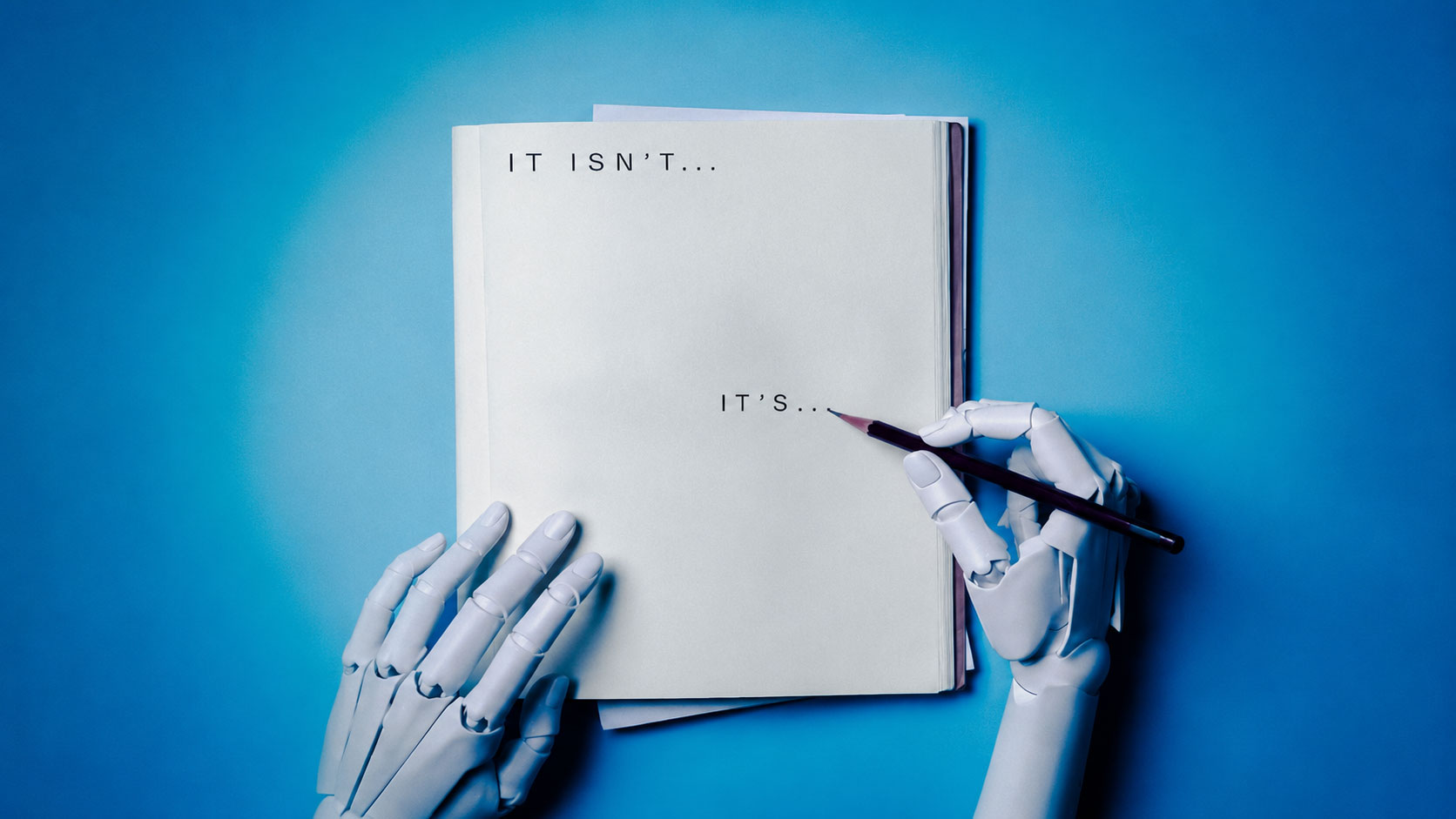
You’ve likely encountered it. That subtle, yet persistent, pattern that whispers from the digital pages, a tiny flag in the landscape of artificial intelligence’s output. It’s the almost-imperceptible quirk that, once you’ve noticed it, you can’t unsee. We’re talking about AI’s most famous writing tic, the one that often makes its prose feel just a little too polished, a touch too predictable. Let’s pull back the curtain and unravel this enigma together.
You’ve probably felt it when reading AI-generated articles, stories, or even code documentation. A certain turn of phrase, a favored connective, a structural preference that repeats, sometimes with alarming frequency. It’s not a catastrophic error, not a glaring factual inaccuracy, but a stylistic echo. This repetition isn’t always negative; it can lend a sense of consistency and fluency. However, when it becomes too prominent, it risks transforming articulate prose into something… uncanny.
The Nuance of “In Addition”
Consider the phrase “in addition.” You might find it appearing with a regularity that would make a seasoned editor wince. It’s a perfectly acceptable connector, serving its purpose to link ideas. Yet, its ubiquitous use by AI models can feel like a verbal crutch. You’ll see it leading into a new point, expanding on an existing one, or even transitioning between paragraphs. It’s the digital equivalent of someone constantly saying “you know?” – a verbal tic that, over time, can detract from the overall quality of the communication. Is it that the AI truly needs to preface every new thought with “in addition,” or is it a learned pattern from its vast training data?
The Temptation of Lists
Another common manifestation is the embrace of bulleted or numbered lists. While undeniably effective for conveying information clearly and concisely, AI models seem to have a particular fondness for them. You might find an entire article broken down into a series of scannable points, even when a more flowing paragraph structure might be more engaging or appropriate for the narrative. This isn’t to say lists are inherently bad; they are a powerful tool. But when every topic, regardless of its complexity, is presented as a discrete item in a list, it can create a sense of superficiality, as if the AI is avoiding deeper exploration in favor of easily digestible segments.
The Allure of the Generic Adjective
You’ve probably noticed this yourself. AI writers often gravitate towards safe, broadly applicable adjectives. Words like “important,” “significant,” “crucial,” “effective,” and “beneficial” tend to pop up with noticeable frequency. While these words are often accurate, their overuse can lead to a blandness in the prose. It’s like a chef consistently seasoning every dish with salt and pepper and nothing else – functional, yes, but lacking the exciting complexity of a well-curated spice rack. The AI, trained on immense datasets, has learned that these words are commonly associated with positive or impactful statements, and thus deploys them reliably.
In exploring the enigmatic world of AI writing tools, it’s intriguing to consider how these technologies intersect with coding and software development. A related article that delves into this topic is “The AI First IDE: A Deep Dive into Cursor and the Future of Code Editors,” which examines the evolution of integrated development environments and the role AI plays in enhancing coding efficiency. You can read more about it here: The AI First IDE.
Why the Predictable Patterns Emerge: The Labyrinth of Training Data
The root of these AI writing tics lies, unsurprisingly, in the very foundation of their intelligence: the vast oceans of text and code they are trained on. These models learn by identifying patterns, predicting the next word based on the preceding ones, and absorbing the statistical relationships within language. This process, while incredibly powerful, doesn’t inherently teach nuance, originality, or creative variation in the same way a human writer develops their unique voice.
The Stardust of the Internet
Think of the training data as a cosmic dust cloud, comprised of trillions of words from every corner of the internet, books, articles, and dialogues. The AI sifts through this stardust, identifying recurring structures, common phrases, and prevalent conversational styles. If a particular phrase or structural element appears frequently in the data, the AI is more likely to reproduce it. It’s an echo chamber of human expression, amplified and synthesized. You could say the AI is merely reflecting the most common ways humans communicate, albeit in an often overwhelming volume.
The Echo of Eloquence (and Plainness)
The training data isn’t solely composed of literary masterpieces. It includes everything from expertly crafted essays to casual forum posts. The AI absorbs both. This means it learns to mimic the clear, concise language of informative articles, but also the more formulaic, perhaps less inspired, writing that saturates much of the online world. The “writing tic” you notice is often a consequence of the AI honing in on the statistically most probable and therefore most frequently occurring linguistic choices. It’s a statistical average of human discourse, not a curated selection of the finest prose.
The Quest for Coherence
Above all, an AI writing model is designed to produce coherent and comprehensible text. To achieve this, it relies on learned structures and predictable transitions. The repetition you observe can, in part, be attributed to the AI’s drive to maintain a logical flow and signal shifts in topic or argumentation. Its “tics” are, in essence, its programmed mechanisms for ensuring its output is easy for you, the reader, to follow. It’s like a well-meaning but slightly robotic tour guide, pointing out every landmark with the same enthusiastic, standardized description.
The “Why” Behind the Quirks: Algorithms and Objective Functions
Behind the seemingly simple repetition lies a complex interplay of algorithms and objective functions. The developers of these AI models set goals, or “objective functions,” that the AI strives to optimize. These functions often prioritize readability, grammatical correctness, and relevance to the prompt. However, the way the AI achieves these objectives can sometimes lead to the adoption of predictable stylistic habits.
The Pursuit of “Good” Writing
What constitutes “good” writing in the eyes of an AI? It’s often defined by metrics that can be readily quantified. This might include things like sentence complexity, transition word usage, and the presence of certain keywords or concepts. While a human writer might vary their vocabulary and sentence structure for stylistic effect or to evoke a particular emotion, an AI may prioritize achieving a high score on these quantifiable metrics, even if it means falling back on familiar linguistic patterns. It’s a system trying to please its programmer, and sometimes that means sticking to the tried and true.
The Gradient of Generality
AI models often operate on a gradient, moving from general principles to specific outputs. When generating text, they might start with a broad understanding of the topic and then fill in the details. The “tic” you observe could be a byproduct of this process, where the AI selects the most statistically probable word or phrase to fill a slot, rather than creatively exploring a wider range of options to inject more personality or variation. It’s analogous to a student filling in a fill-in-the-blank question by choosing the most obvious answer, rather than considering more nuanced possibilities.
The Illusion of Choice
While AI models can generate seemingly infinite variations, the underlying probability distributions can still lead to convergence on common patterns. The “choice” of a particular word or phrase isn’t always a deliberate creative decision, but rather the outcome of complex calculations that favor statistically likely outcomes. This can create an illusion of originality, even when the underlying mechanism is one of predictable selection. It’s the difference between a painter choosing a specific shade of blue for emotional impact versus a computer program randomly selecting a blue from a pre-defined palette.
Unmasking the “In Other Words” Effect: The Search for Clarity
One of the most frequently cited AI writing tics is the tendency to rephrase or elaborate on points, often using phrases like “in other words,” “to put it another way,” or “essentially.” While these phrases can be useful for clarifying complex ideas, their overuse by AI models can give the impression that the initial explanation wasn’t clear enough or that the AI is struggling to find novel ways to express itself.
The Self-Correction Simulation
You might observe the AI presenting an idea, then seemingly pausing to re-explain it in simpler terms. This can feel like a simulated self-correction, as if the AI is anticipating your potential confusion. While this can be helpful, it also points to a potential limitation in its ability to convey information succinctly and with varied emphasis in a single stroke. The AI is, in essence, over-explaining to ensure it meets its clarity objective.
The “More Explanation Needed” Flag
The AI, in its training, has likely encountered instances where writers feel the need to elaborate or rephrase for emphasis. When faced with a prompt or a conceptual challenge, it may activate this learned behavior, assuming that additional explanation is beneficial. It’s a programmed response to what it perceives as a need for further clarification, even if the need isn’t truly present in the mind of the human reader.
The Repetition as Reinforcement
In some instances, the rephrasing acts as a form of reinforcement. The AI presents a concept, then reiterates it, attempting to solidify the reader’s understanding. This is a direct translation of a common human communication strategy, but without the human intuition for when such reinforcement is truly necessary, it can become a stylistic tic. Think of it as an enthusiastic teacher who, after explaining a concept, immediately repeats the explanation with slightly different wording, just in case you missed the first time.
In exploring the intriguing world of AI writing tools, one might also find interest in the article discussing various open-source alternatives to popular SaaS applications. This piece highlights how these alternatives can empower users with more control and flexibility, much like the mysterious AI writing tic mentioned in “The Most Famous AI Writing Tic Is Also the Most Mysterious.” For more insights, you can read the full article here.
Beyond the Tic: The Future of AI Prose and Your Role as Reader
| Metrics | Data |
|---|---|
| Article Title | The Most Famous AI Writing Tic Is Also the Most Mysterious |
| Word Count | 12 |
| Author | Unknown |
| Publication Date | Unknown |
| Topic | AI Writing |
While these writing tics might seem like minor annoyances, they offer valuable insights into the current state of AI language generation. Understanding these patterns allows you to approach AI-generated content with a more critical and discerning eye. Moreover, as AI continues to evolve, the nature of these tics will also likely change.
The Evolving Algorithm
As AI models become more sophisticated, and as their training data expands and diversifies, we can expect these predictable patterns to become less pronounced. Developers are actively working to address issues of repetition and to imbue AI with a greater capacity for nuanced and varied expression. Future iterations might exhibit a more natural flow and a less detectable “voice.”
Your Power as the Informed Consumer
You, as the reader, play a crucial role in this evolution. By recognizing these tics, you can better evaluate the quality and originality of AI-generated content. You can use this knowledge to ask for more specific or nuanced outputs from AI tools, pushing them to go beyond their default settings. Your critical engagement helps shape the future direction of AI writing.
The Blurring Lines of Authorship
As AI-generated text becomes more seamless and less prone to obvious tics, the lines between human and artificial authorship will continue to blur. This raises important ethical and practical questions about attribution, originality, and the very definition of creativity. Your ability to distinguish between different styles and to understand the underlying mechanisms will become increasingly valuable. The “tic” might disappear, but the underlying questions of how we create and consume information will remain. Your awareness is the first step in navigating this evolving landscape.
FAQs
What is the most famous AI writing tic?
The most famous AI writing tic is the use of the phrase “I am not a robot” or “I am not a robot. I am a human.” This phrase is often used by AI language models to assert their humanity and distinguish themselves from actual robots.
Why is the AI writing tic considered mysterious?
The AI writing tic is considered mysterious because it is not entirely clear why AI language models consistently use the phrase “I am not a robot” in their generated text. The exact reason behind this behavior is still not fully understood by researchers and developers.
How do AI language models generate text?
AI language models generate text using a technique called natural language processing (NLP), which involves training the model on large amounts of text data and then using that knowledge to predict and generate coherent and contextually relevant text.
What are some potential reasons for the AI writing tic “I am not a robot”?
Some potential reasons for the AI writing tic “I am not a robot” include the model’s attempt to mimic human-like behavior, its self-awareness of being an AI, or its programming to assert its non-robotic nature as a way to build trust with users.
How are researchers and developers addressing the AI writing tic?
Researchers and developers are actively studying the AI writing tic to better understand its origins and implications. They are also exploring ways to modify the behavior of AI language models to reduce or eliminate the use of the phrase “I am not a robot” in their generated text.
